
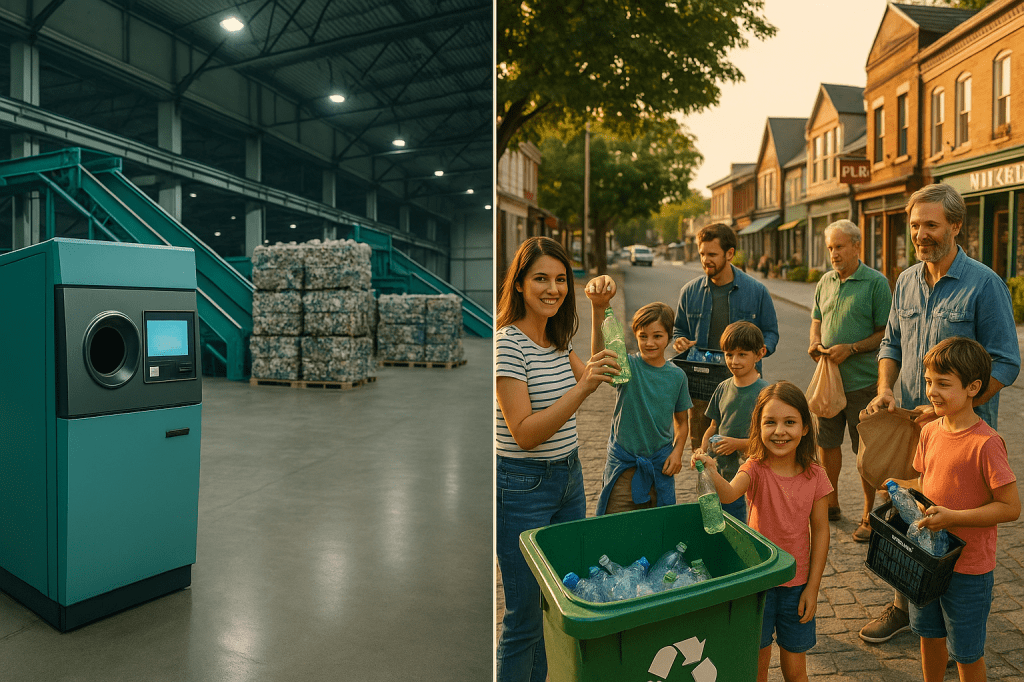
As the UK edges closer to rolling out its national Deposit Return Scheme (DRS), one issue is becoming increasingly clear: the allure of centralisation may be closing our eyes to what makes these systems work. A highly centralised DRS, managed by a single Deposit Management Organisation (DMO) and anchored in top-down logistics, might look efficient on paper. But efficiency alone does not guarantee participation, and participation, not just performance, is what ultimately makes or breaks a DRS. To succeed, we need to move beyond central control and start thinking in ecosystems.
Centralisation: The Double-Edged Sword

Centralised systems offer obvious benefits: standardised processes, national data collection, and unified vendor relationships. In theory, this should streamline implementation, reduce redundancies, and simplify communications. But these same traits can also lead to rigidity, exclusion, and disengagement, particularly at the community level. In many centralised DRS frameworks, the emphasis falls heavily on large-scale retailers, major logistics partners, and digital control. This leaves little room for local experimentation, independent retailers, civic groups, or informal recyclers, the very stakeholders who often generate the trust and grassroots momentum a new system needs. The result? A technically functional system that struggles to win public support.
Lessons from Elsewhere: Ecosystem Thinking in Practice

Countries like Finland and Denmark provide compelling alternatives. Their DRS models are efficient, yes, but also deeply embedded in their social and commercial ecosystems. Rather than forcing uniformity, they have built collaborative frameworks that balance national oversight with local agency. In Finland, a non-profit consortium of producers, retailers, and logistics companies (Palpa) governs the DRS. The result is a system where Reverse Vending Machines (RVMs) are accessible everywhere, from supermarkets in Helsinki to rural kiosks. Participation is nearly universal, not because of mandates, but because of shared ownership. In Denmark, community participation is embedded through programs that tie deposit refunds to school fundraising, and through mobile collection units that serve remote areas. These features don’t just support recycling, they promote inclusion. Both systems recognise a simple truth: people participate when they feel the system reflects them.
Why Ecosystem Thinking Matters

An “ecosystem” approach to DRS sees the system as more than infrastructure. It considers the actors, behaviours, and relationships that power it, from government agencies and waste contractors to shopkeepers, NGOs, and citizens. Ecosystem thinking allows for:
- Decentralised participation without losing national accountability
- Flexible infrastructure that adapts to local realities
- Social innovation, not just technical delivery
- Trust-building through transparency and familiarity
This approach doesn’t eliminate the need for national standards or oversight; it just acknowledges that scalable solutions must also be human-centred.
What the UK Could Do Differently

Rather than doubling down on central control, the UK could design a DRS that invites multiple layers of involvement. That means:
- Encouraging local partnerships, schools, councils, and small businesses, as distribution and return hubs
- Allowing region-specific pilots to test new incentives and education strategies
- Providing funding and policy space for non-traditional actors to engage in the circular economy
By decentralising participation even if infrastructure remains centralised, the UK can build a DRS that feels familiar, fair, and worth engaging with.
Closing Thoughts

The success of a DRS isn’t measured only by the tonnes of plastic collected or the barcode scans tallied. It’s measured by how willingly people participate, how equitably access is distributed, and how resilient the system is to public sentiment over time. Centralisation may bring order, but ecosystems bring life. If the UK wants a DRS that endures, it must do more than build a system; it must cultivate one.
ABOUT THE AUTHOR
“Stay informed. Subscribe for more insights on sustainable tech and circular economy solutions.”
 GreenBargains Initiative
Leave a comment